How the medium is evolving
Video games grew from text to pictures to animation to 3D, each step adding a layer of presentation on top of the same underlying idea. Story Generators are following a similar path, in a fraction of the time, because the underlying models are improving so quickly.
Text is where the medium is now, as interactive fiction was in 1977. It is the cheapest layer to generate and the easiest to keep faithful to canon, which is why it comes first.
Illustrated stories sit right beside text. The story and dialogue are generated live, while the pictures are pre-generated by the studio: illustrated scenes, characters and locations drawn ahead of time from the canon and shown as the story reaches them, alongside illustrated puzzles and other light game elements. Because the art is made in advance, it can be checked and kept consistent, so a character's face and a city's streets look the same from scene to scene. This is the step that corresponds to Mystery House adding pictures in 1980, and it is already here.
Voice is arriving in two steps. First, text stories with audio: narration and character dialogue performed by expressive voices, closer to radio drama than to a book. Next, live voice conversation with the characters themselves, where the player speaks and a character answers out loud, in her own voice, from canon.
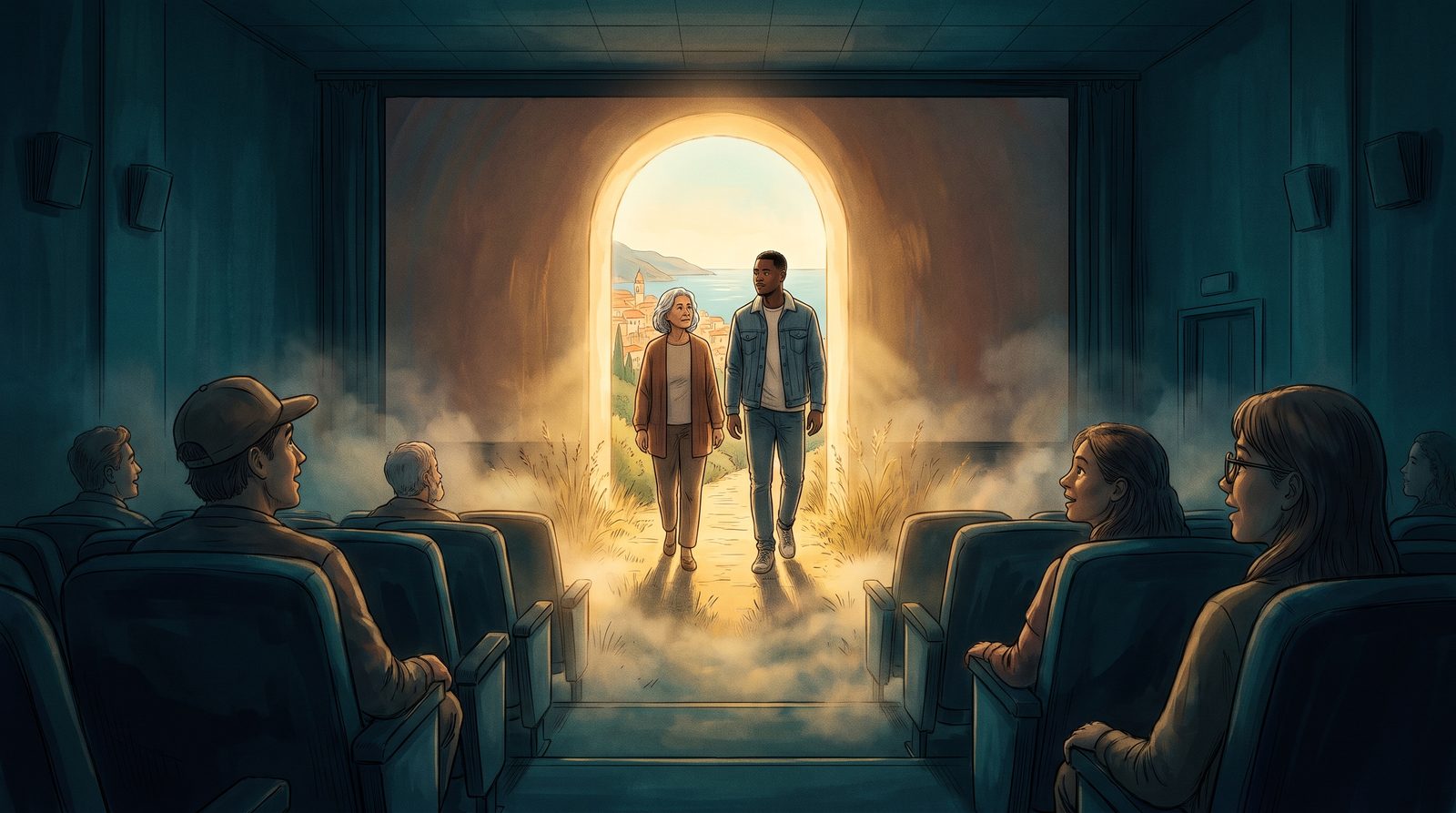
Generative interactive film comes next: scenes rendered as moving pictures, cut and paced like cinema, but performed differently for each viewer. We explore this in Every viewer a different cut.
3D generative worlds are the far end of the staircase: places you can walk through, rendered by world models, populated by characters performed from canon. At that point the line between Story Generators and games will look thin from the outside. It will not be thin underneath. A 3D Story Generator is still a world performing an authored canon, live, for one player. A 3D classical game is still a machine built in advance.
Omni models: one mind across every medium
Each step on the staircase has so far been built from separate parts: one model writes the story, another paints the scene, another speaks the lines. Every handover is a seam where a character's voice, a room's lighting or the facts of the plot can slip. The next wave of Story Generators will be powered by omni systems: single models that take in text, audio and video and give back text, audio and video, coherently, from one understanding of the scene.
That coherence is what matters. A character who is written, voiced and shown by the same model sounds like the person on the page and looks like the person in the last scene. A player can speak to her, show her something, or type, and she answers in kind without breaking. For a medium built on canon, omni models remove the seams between layers, so the canon can steer every one of them at once.
Generative VR: the next great leap
Beyond the screen lies generative virtual reality: worlds generated around the player in real time, in every direction, at the scale of a city. We think this will be viewed the way we now view the leap from text adventures to modern 3D worlds, such as the explorable environments of Syberia or the living simulation of Grand Theft Auto. In the late 1970s a cave was a paragraph of text. A few decades later it was a place you could walk into. Generative VR is a leap of the same size for Story Generators.
It will not come cheaply. Rendering a generative VR world, two high-resolution views at a high frame rate, with every surface, character and line of dialogue generated live, will require tremendous amounts of compute. Our view is that it arrives in the mid to late 2030s, as the cost of generation keeps falling and the hardware to run it reaches homes.
When it does, we expect it to become a dominant form of video entertainment among younger generations. The reasons are the same ones that make Story Generators compelling today, multiplied: content that never runs out, immersion that surrounds you, and free-roam worlds that expand in whatever direction the player chooses to go, rather than ending where a studio stopped building. Canon still anchors those worlds, keeping their history, characters and truths intact, but the map is no longer fixed in advance. It grows from the player's choices.
This is the road we are on. Our name, Senrama, is a blend of sensory and diorama: a miniature 3D world that engages the senses. It describes where we believe entertainment is heading, from text, through illustration, voice and film, to immersive and passive 3D computational entertainment: worlds you can step into and act in, and worlds you can simply sit back and watch unfold around you.
Where it goes: interactive film and 3D generative worlds
Film gave audiences a story they watch. Games gave them a world they act in. Story Generators, at their furthest point, give both at once: a film that listens, and a world that has a story to tell.
Picture a detective story set in a city its writers have mapped street by street. You walk into a pub that exists in the canon, and the landlady who runs it, whose history, debts and secrets are written down, looks up and recognises you from last week. You can ask her anything. She will answer as herself, and she will not tell you what she has no reason to tell a stranger. The scene is lit and shot like a film, the camera finding her face as she lies. Nothing about the exchange was scripted. Everything about it was authored.
Getting there needs three things to come together: world models that stay consistent for hours rather than minutes; character models that hold to canon under pressure from millions of players; and authoring tools that let a writer build all of it without becoming an engineer. Each of these is moving quickly. None of them, on its own, is the medium. The medium is what happens when they are joined by a canon.
The rise of generative universes
Push the medium far enough and you arrive at generative universes. A generative universe is an infinite, omni, narrative universe: transmedia by nature, directed by human writers through canon, and enjoyed by people who come to it in place of a shelf of books, a stack of TV series and a library of games. Instead of one show there are many, running in the same world. Instead of a franchise split across products, there is one place where the fiction lives, followed on a phone on the commute and in immersive VR at home, and so epic and so dynamic that, for its audience, it can stand in for traditional media altogether.
A classical game world ends where the studio stopped building. A generative universe keeps going: the next street, the next conversation and the next episode are generated as the audience reaches them, bound to what the writers established. It is the furthest point of the umbrella this manifesto describes: one experience across every medium, rather than one story scattered across many products.
A subculture first: the generators
For now, this is a niche. The people who live in generative universes are a subculture, as early gamers were: a small, devoted audience who would rather follow a story that answers them than one that does not. Gamers took their name from what they played, and this audience may take theirs the same way, calling themselves generators.
Niches like this do not stay small. Video games began as a pastime for hobbyists and grew past film and music combined. We think generative universes can grow past gaming itself, for a reason games do not have: a live feedback loop between canon and audience. Writers set the world and its rules; players show, instantly and in their millions, which way they want the story to go; the next scene is generated in response. No release schedule can move that fast.
Anywhere, within guardrails
In a generative universe the story can go anywhere. That is its power and its risk. Left to drift, a story can slide too dark, into cruelty that serves nobody, or too light, into a frictionless comfort where nothing is at stake. Both kill fiction. So generative universes need guardrails, and they belong in the canon: writers decide the tone a world can hold, the lines it will not cross and the weight it must keep. The audience steers; the canon keeps the story worth steering.
We explore the idea further in our essay The rise of generative universes.