Game generators
Procedural generation vs generative AI in games
Procedural generation builds worlds from rules a designer wrote. Generative AI builds them from patterns a model learned. Here is how they differ, what each is good at, and why the best games will use both.
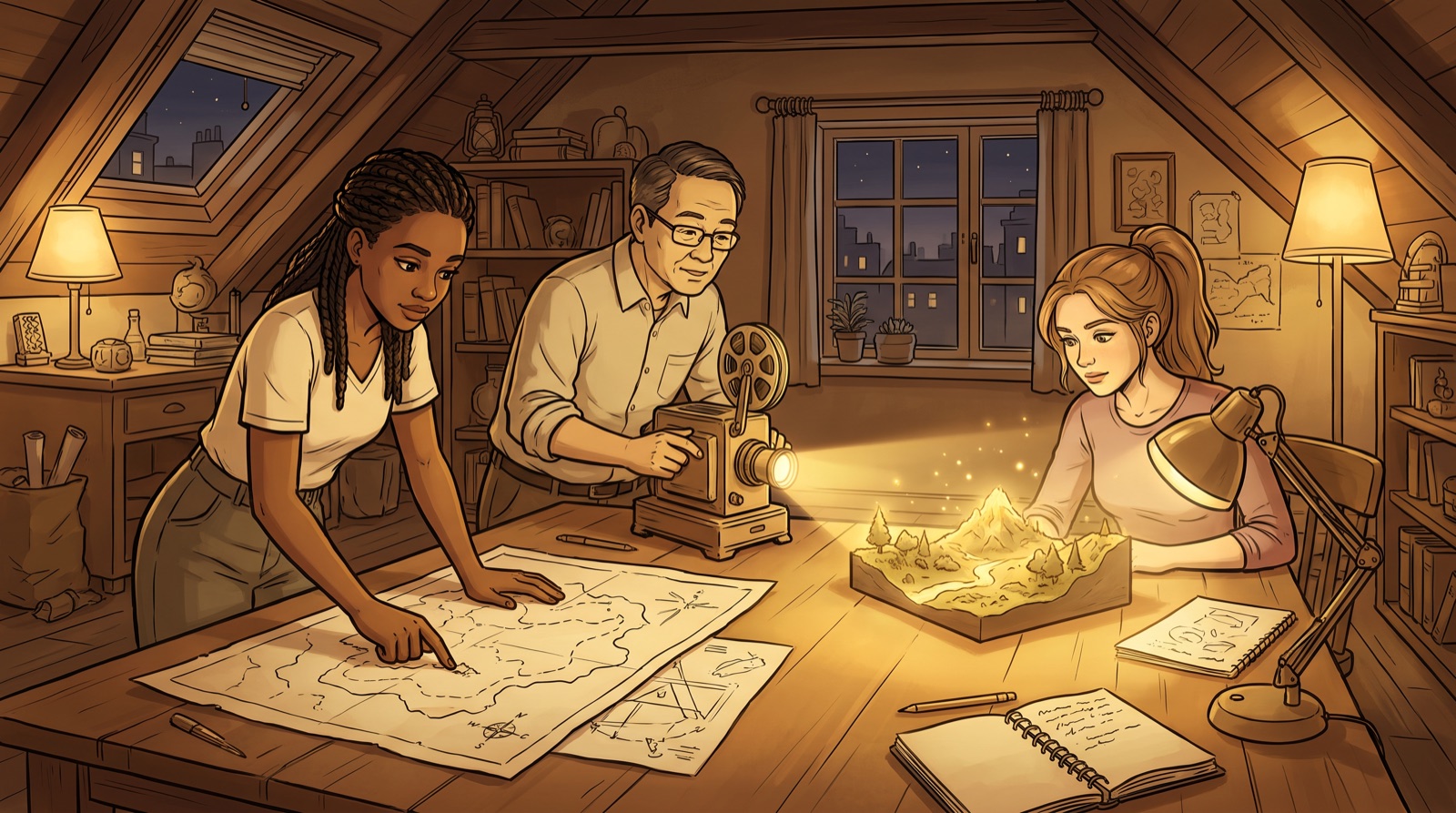
People often use “procedural generation” and “generative AI” as if they meant the same thing. Both make game content that nobody placed by hand. Both can produce more than a team could ever build. But they work in opposite ways, they fail in opposite ways, and the difference decides what you can build with them.
This guide explains each approach, compares them on the points that matter to a studio, and describes how they are starting to work together.
What is procedural generation?
Procedural generation creates content from rules. A designer writes an algorithm, gives it a random seed, and the algorithm produces a level, a map or a planet. The same seed gives the same result every time.
The idea is old. Rogue, released around 1980, generated its dungeon levels, monster encounters and treasure afresh for each playthrough, according to its history. Entire genres grew from that single trick.
Modern examples run at far greater scale. No Man’s Sky is described as a deterministic procedural universe with over 18 quintillion planets. Deterministic matters here: two players who visit the same coordinates see the same planet, because the planet is computed from the numbers, not stored.
Some procedural methods learn from examples without using a neural network. Maxim Gumin’s WaveFunctionCollapse takes a small sample image and produces new output that is locally similar to it, using only patterns present in the input. It is still a hand-built algorithm. Nobody trained a large model.
What is generative AI in games?
Generative AI creates content from learned patterns. A model is trained on a large amount of data (text, images, video, recorded gameplay) and then produces new material that resembles what it saw. Nobody writes the rules. The model finds them.
In games this now covers several things:
- Assets: textures, concept art, voice and music.
- Text: dialogue, quest copy, character backstories.
- Behaviour: characters that respond in their own words. We cover this in our guide to intelligent NPCs.
- Whole environments: world models that predict each frame as the player acts. Our explainer on how AI world models work covers the main designs.
The last item is the most radical. Google DeepMind describes Genie 3 as generating dynamic worlds from a text prompt that you can navigate in real time at 24 frames per second, with consistency held for a few minutes at 720p. There is no level file and no engine rules written for that world. The model is the world.
An earlier research result made the same point with an existing game. The GameNGen paper, Diffusion Models Are Real-Time Game Engines, trained a diffusion model on DOOM and ran it interactively at over 20 frames per second on a single TPU. Its authors report that human raters were only slightly better than chance at telling short clips of the simulation from the real game.
The core difference: rules or patterns
Everything else follows from one distinction.
A procedural generator knows its rules. It can tell you why a river runs where it does, because a function put it there. A generative model knows what things tend to look like. It can produce a convincing river, but it has no rule that says water must run downhill unless it learned that from the data, and it may get it wrong.
That gives each approach a different character.
Control and predictability
Procedural systems are controllable. Change a parameter and you know what will change. You can guarantee that every level is completable, because you can write a check for it.
Generative models are steered, not programmed. You influence them with prompts, reference images, fine-tuning or actions, and you accept some variation. Guarantees are harder. You usually test the output instead of proving it.
Consistency and memory
Procedural worlds are consistent by construction. Return to a seed and the world is the same. Nothing needs storing.
Generative worlds have to be taught to remember. Genie 3’s few minutes of consistency is a real achievement, and also a clear limit. A game needs a place to stay the same for hours, across sessions. This is the problem we describe in memory in AI games: a model’s context is not a save file.
Variety and meaning
Procedural generation produces variety of arrangement. Ten thousand planets can differ in terrain and colour and still feel alike, because a recombined set of parts only goes so far. Designers sometimes call this “procedural oatmeal”: lots of different content, all of it bland.
Generative models can vary meaning, tone and voice, which rules struggle to do. A character can describe the same event differently depending on who they are. That is the strength we explore in simulated worlds.
Cost and speed
Procedural generation is cheap to run. A seed and a function can produce a map on a phone in milliseconds, with no server.
Generative AI costs compute at the moment of play or at the moment of production. Real-time world models need serious hardware, which is why recent work focuses on making them lighter. Cheaper inference is the main reason this comparison keeps shifting.
Authorship
A procedural generator carries its designer’s intent in its rules. You can read the code and see what the designer valued.
A generative model carries the intent of its training data and whoever steers it. The designer’s job moves from writing rules to shaping a system: choosing constraints, curating examples and deciding what the model may not do. We discuss what that means for creators in AI interactive storytelling and authorship.
Side by side
| Procedural generation | Generative AI | |
|---|---|---|
| Source of content | Hand-written rules and a seed | Patterns learned from data |
| Repeatability | Same seed, same result | Varies unless carefully controlled |
| Guarantees | Can be proven or checked in code | Usually tested, rarely proven |
| Strength | Scale, consistency, low cost | Meaning, voice, visual richness |
| Typical weakness | Sameness across large spaces | Drift, forgetting, inference cost |
| Designer’s role | Write the rules | Shape and constrain the model |
Which should a studio choose?
For many projects the honest answer is both, with each doing the job it is suited to.
A useful division is structure from rules, surface from models:
- Let rules hold the truth. Geography, economy, quest state, inventory and who knows what should live in ordinary code or data, where it is exact, saved and testable.
- Let models tell it. Descriptions, dialogue, rumours, voices and visual variation can be generated from that state, so they stay faithful to it.
- Check the seams. Validate generated output against the rules before the player sees it. If a character mentions a bridge that the world state says is destroyed, reject the line and try again.
This pattern appears across current research. Recent work such as the Streaming Code World Model points the same way, with a model producing structured, inspectable world logic rather than only pixels. Hybrid designs like this keep the reliability of procedural systems and add the expressiveness of learned ones.
Common mistakes
- Using a model where a rule would do. If a value must be exact, such as a score, a price or a door lock, do not ask a model to remember it.
- Using a rule where a model would do. Hand-writing ten thousand variations of a shopkeeper’s greeting is slow and still repetitive.
- Skipping evaluation. Procedural output can be unit-tested. Generated output needs sampling, review and automatic checks, or it will drift off tone.
- Ignoring latency. A line of dialogue that arrives three seconds late breaks a scene, however good it is.
Where this is heading
The boundary is moving. World models are getting faster, as our coverage of Matrix-Game 4 and WorldPlay2 shows, and procedural tools increasingly use learned components. In a few years the question may be less “which one?” than “which layer?”.
What will not change is the need for someone to decide what is true in the world, what is allowed, and what the player should feel. Rules and models are both ways of carrying that decision into a game. If you want to see how that thinking shapes finished products, read our piece on games as intelligent products.
Frequently asked questions
Is generative AI replacing procedural generation? No. They solve different problems. Procedural generation remains the better tool where exactness, repeatability and low cost matter.
Is a world model a kind of procedural generation? Not in the usual sense. A world model learns to predict scenes from data. A procedural generator executes rules a person wrote.
Which is better for an open-world game? Usually a combination: rules to keep the world consistent and persistent, and models to give it voice and variety.