World models
Kyutai CADRE: cutting action lag in AI world models
Kyutai has released CADRE, open video autoencoders built so interactive world models react in under 230 ms on one GPU. The paper shows why borrowing a text-to-video autoencoder makes every key press feel late.
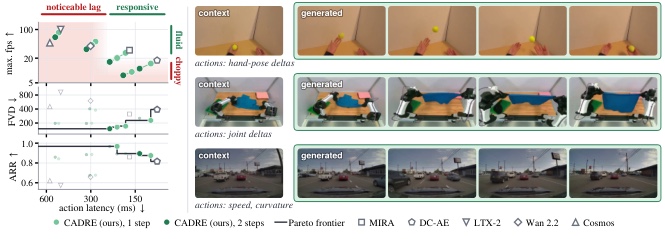
Kyutai, the open-science lab in Paris, has released CADRE, a family of open video autoencoders designed for interactive world models. Its argument is simple: the part of a world model that compresses video decides how late every action feels, and most teams borrow that part from the wrong place.
What happened
A video world model does not generate pixels directly. An autoencoder squeezes video into a compact latent space, the world model generates there, and the decoder turns the result back into frames. Many world models reuse the autoencoder of a text-to-video generator such as Wan 2.2 or LTX-2.
Those autoencoders were built for offline clips. They pack several frames into one latent frame, which is cheap. But an interactive model can only generate a latent frame once it knows the actions for every frame inside it, so each packed frame adds lag. Kyutai says a typical 8x temporal compression delays every action by at least 400 ms at 20 frames per second. It cites research that people notice their own movement is late beyond about 230 ms.
How CADRE works
CADRE reads each frame with a frozen DINOv3 image model and a small trained bottleneck that sets the compression. A causal diffusion decoder, distilled down to one or two steps, rebuilds the video. Only the bottleneck differs between the seven released models, so the team could compare compression levels fairly. The autoencoders were trained on 23 public video datasets, about 76,000 hours.
The same world model was then trained on each autoencoder in four settings: human manipulation, robot manipulation, driving and indoor navigation.
The numbers
- World models on CADRE run at 20 frames per second on one H100 and react in under 230 ms. Among the baselines, only Kyutai’s earlier MIRA autoencoder matches that latency, with worse image and motion quality.
- CADRE forms most of the latency-quality frontier against the autoencoders of Wan 2.2, Cosmos, LTX-2, DC-AE and MIRA, especially with a moving camera.
- Four findings: a diffusion decoder is sharper than a regression decoder at strong compression; it is better to compress time in the autoencoder than inside the world model; a still camera tolerates temporal compression while a moving camera favours keeping frames and compressing space; and coarse tokens hurt motion before image quality.
- In robot manipulation, going from 16x to 32x spatial compression left image quality almost unchanged (FID 8.53 to 8.92) but made motion error 2.4 times worse.
Limits
The demos cover manipulation, driving and indoor walks, not game worlds. Kyutai’s own list of open questions includes how well the models grasp physics and how they carry over to more general world models. The code is MIT licensed, but the weights are CC BY-NC 4.0, so they are not for commercial use.
Our take
Game teams usually judge a world model by how good a frame looks. CADRE is a reminder that feel matters just as much: a beautiful world that answers 400 ms late plays badly. As we explain in how AI world models work, a world model is only a game if it keeps up with the player. If you are choosing or training one, measure action latency as carefully as image quality, and pick compression to suit your camera.